In a study published in Science Advances on December 19, researchers from Xishuangbanna Tropical Botanical Garden (XTBG) of the Chinese Academy of Sciences, along with collaborators from international institutions, explored the impact of mountain building and climate cooling over 30 million years across five major mountain systems in the Northern Hemisphere and revealed that these processes are key drivers of the rich plant diversity found in the Earth’s alpine biome.
Mountain regions harbor a disproportional share of the world’s plant species, but the processes responsible for assembling this diversity over deep time have remained unclear. To address this question, the researchers combined phylogenetic analyses with geological context and paleoclimate reconstructions, allowing them to identify the roles of mountain building and climate change in the evolutionary assembly of alpine floras.
They examined the evolutionary history of 34 groups of flowering plants, covering 8,456 species. They reconstructed when and where these plants spread and diversified across different mountain ranges. Using paleoclimate reconstructions, they subsequently mapped how progressive climate cooling expanded cold habitats, thereby connecting once-separate high-altitude regions over millions of years.
According to XING Yaowu of XTBG, co-corresponding author of the study, “Our work links plant evolution with the Earth’s geological and climate history, showing how ancient mountains and climate changes have shaped alpine life in clear, predictable ways.”
Specifically, the results indicate that the expansion and diversification of alpine plant groups relied on both mountain uplift and cooler global temperatures regardless of where or when these groups originated. As mountains rose, they created new habitats and increased topographic complexity, allowing plants to diversify locally. Later, as the climate cooled, cold environments expanded beyond mountain peaks and across high latitudes, increasing ecological connectivity for cold-adapted plants and enabling them to disperse and spread across mountain ranges.
At the same time, the researchers found that different mountain systems exhibited distinct evolutionary mechanisms. For example, the Tibet-Himalaya-Hengduan (THH) region acted as a “cradle”—with over half of new species arising from in situ diversification, while European and Irano-Turanian alpine floras were assembled mainly from local mid- to low-elevation lineages that adapted to alpine habitats. In contrast, the Tianshan Mountains largely “imported” species from the THH region.
Across mountains, tectonic uplift and the development of rugged, heterogeneous landscapes was found to consistently accelerate the formation of new plant species within regions, highlighting the evolutionary consequences of geological process for alpine biodiversity.
“These asynchronous yet predictable assembly dynamics help explain why alpine plant communities differ so much from one region to another today,” said DING Wenna, first author of the study.
Following prolonged phases of alpine plant diversification, global cooling intensified connections between cold Arctic and alpine habitats over the last five million years, according to the researchers, turning the boreal-arctic region into a “biogeographic crossroads” for floristic exchange between Eurasia and North America. Together, these findings explain why mountain biodiversity differs among regions by linking regional evolutionary trajectories to contrasting geological and climatic histories.
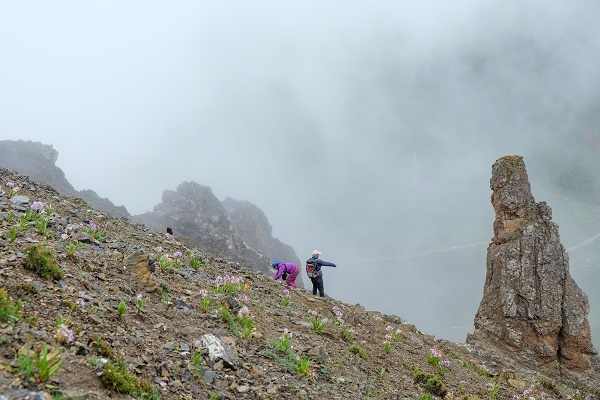
Researchers conduct field study in alpine region. (Image by DING Wenna)
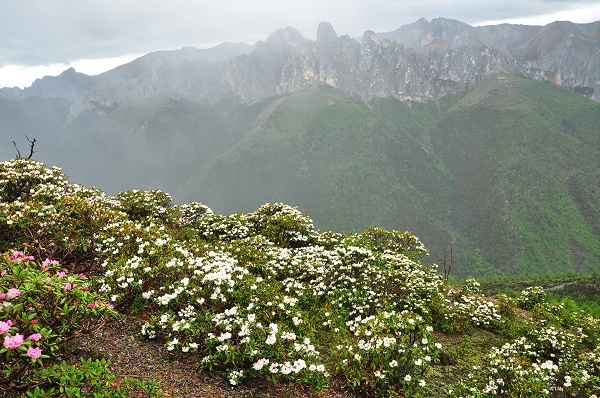
Alpine flora. (Image by DING Wenna)
Available online: 19 December 2025


