Asian elephants (Elephas maximus) are regarded as ecosystem engineers. Root exudates, the primary and secondary metabolites released by plants, are a major source of carbon input to soils and can influence whether carbon is stored long-term or rapidly cycled. Although the roles of Asian elephants in seed dispersal and forest structure are well-documented, their impact on hidden soil processes has remained unclear.
In a study published in Plants, People, Planet, researchers from Xishuangbanna Tropical Botanical Garden (XTBG) of the Chinese Academy of Sciences showed that the destructive foraging behavior of Asian elephants can trigger immediate and species-specific changes in how trees release carbon into the soil through their roots. This finding uncovers a previously hidden pathway linking animal disturbance to soil carbon dynamics, with important implications for conservation and climate resilience.
The researchers investigated how elephant foraging influences belowground carbon cycling and soil ecological processes by altering root exudation in tropical forest tree seedlings.
To simulate elephant herbivory, the researchers applied three levels of damage to saplings of three tree species commonly consumed by elephants: Macaranga indica, Ficus hispida, and Bauhinia variegata. They applied three damage levels: no damage (control), mild (10% aboveground biomass removed), and severe (50% removed). Root exudation rates were then measured over a 96-hour period.
They observed significant differences of the tree species in response to damage. Macaranga indica temporarily doubled its root carbon exudation rate within 24 hours after mild damage, but showed no response to severe damage.Ficus hispida increased its exudation rate significantly, but only 72-96 hours after severe damage, with no change from mild damage. Bauhinia variegata showed no detectable change in exudation in response to either level of damage.
They also found that the exudation patterns were linked to specific root traits and local soil properties, supporting a framework where a plant’s physical characteristics and its environment shape its response to disturbance.
“This research gives us one more compelling reason to protect ecologically functional elephant populations.Elephants don’t just reshape the forest aboveground, but their foraging sends rapid signals underground that can shift microbial communities and alter carbon pathways,” said Dr. Ahimsa Campos-Arceiz of XTBG.
Their findings provide scientific support for nature-based solutions such as elephant-friendly forest management. They also emphasize the importance of conserving functionally important animal populations and monitoring soil processes to enhance climate adaptability.
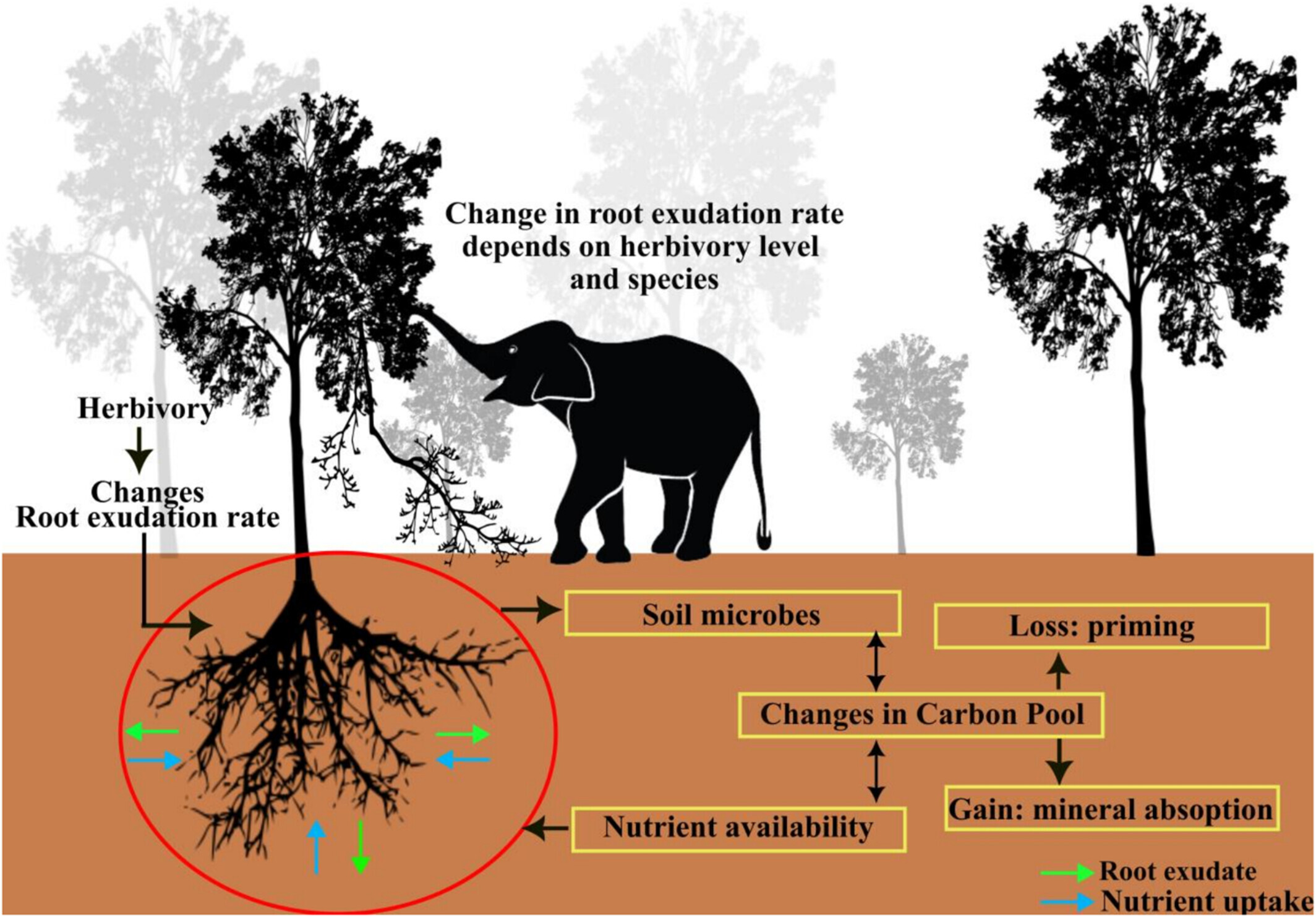
Destructive foraging habits of Asian elephants can cause immediate, species-specific changes in how trees release carbon into the soil through their roots. (Image by Pratibha Khatri)
First published: 29 December 2025


