Orchid diversity and conservation are tightly linked to the evolution of orchid lifeforms (e.g., epiphytic or terrestrial) as epiphytic species are highly sensitive to environmental changes and includes super-high species diversity. However, the factors that drive the evolution of orchid lifeform remain unclear.
In a study published in Plant Diversity, researchers from Xishuangbanna Tropical Botanical Garden (XTBG) of the Chinese Academy of Sciences and Fujian Agriculture and Forestry University highlight the dominant role of evolutionary history in shaping epiphytic diversity and offer fresh insights for orchid conservation. They revealed that species evolution is the primary driver of whether orchids evolve as epiphytic (growing on trees) or terrestrial (ground-dwelling) plants.
The researchers analyzed a global phylogeny of 2,272 orchid species, representing all five subfamilies and 302 genera. Using a unified analytical framework, they quantified the relative contributions of climate distribution, pollination strategies, pollinator attraction traits, and evolutionary history to orchid lifestyle variation.
They found that Phylogeny alone accounts for 62% of the variation in orchid lifeforms, confirming that evolutionary history is the dominant factor. Pollinator attraction strategies (rewarding vs. deceptive pollination) independently explain an additional 23.9% of lifeform variation. Climate region (tropical, subtropical, or temperate) explains only 3.4% once evolutionary history is accounted for.
The researchers attribute the earlier misinterpretation to differences in evolutionary conservatism, the tendency of traits to retain ancestral states. Orchid lifestyle shows extremely high conservatism, followed by climate distribution (e.g., tropical vs. temperate), while pollination-related traits are far more evolutionarily labile.
The findings offer practical guidance for orchid conservation. Traits with high evolutionary conservatism (e.g., lifestyle, climate distribution) have low adaptive potential. If such traits mismatch current environmental conditions, in-situ conservation in native habitats is recommended. Conversely, traits with low conservatism (e.g., pollination type, pollinator attraction mode) suggest higher adaptive potential; for species threatened due to mismatches in these traits, ex-situ conservation and pre-adaptation to new environments may be more effective.
“Recognizing the dominant role of species evolution in trait evolution provides a more comprehensive framework for understanding the drivers of trait evolution and for guiding orchid conservation worldwide,” said WANG Gang of XTBG.
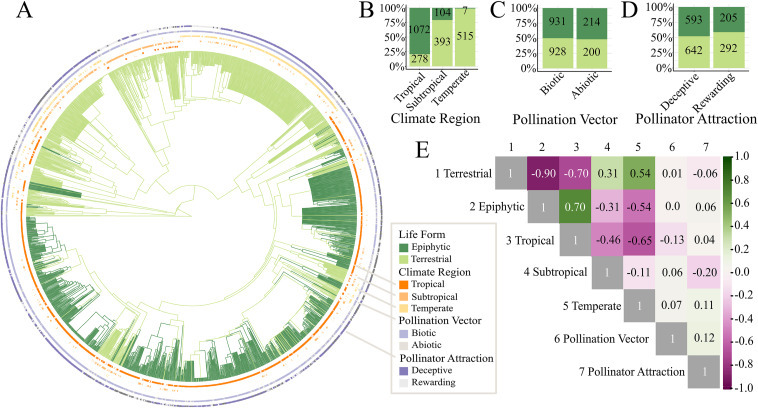
Distribution and correlation of orchid lifeforms and other factors across orchid phylogeny。


