The tribe Marsdenieae includes numerous species of significant economic value. It represents an important lineage within Apocynoideae; however, its plastome evolutionary mechanisms and intergeneric phylogenetic relationships remain unclear.
In a study published in BMC Plant Biology, researchers from Xishuangbanna Tropical Botanical Garden (XTBG) of the Chinese Academy of Sciences and their collaborators reveal complex plastome evolution and proposes key genus-level reclassifications in the ecologically and economically important plant group. They tried to reveal the structural evolutionary history of plastomes in this tribe and optimize its taxonomic framework by analyzing dynamic features of inverted repeat (IR) boundaries, characteristics of repetitive sequences, and phylogenetic signals.
The researchers analyzed 76 plastomes (chloroplast genomes) representing 17 genera and 72 species, including 19 newly sequenced plastomes, making this the most comprehensive genomic study of the tribe to date. Despite retaining a conserved quadripartite structure typical of plant plastomes, they discovered substantial genome size variation ranging from 156,364 to 179,121 base pairs, a difference of nearly 23,000 base pairs.
This size variation is primarily driven by expansion and contraction of the inverted repeat (IR) regions, which are duplicated segments of DNA found in plant plastomes. The study identified five distinct IR boundary types (Types I–V), with Type III inferred as the ancestral state-1. Type IV further diversified into three subtypes (IVa, IVb, and IVc), each corresponding to specific evolutionary clades (Clades A1, A2, and A5).
"These IR boundary variations are not random, they carry strong phylogenetic signals that align with evolutionary relationships," said CHEN Rong. The research team employed EM Mantel tests and Delta statistics to demonstrate that structural variations in the IR boundaries are statistically correlated with the tribe's phylogenetic history.
Molecular evidence supports the division of tribe Marsdenieae into two major clades, but non-monophyly was detected in genera Hoya, Marsdenia, and Dregea. The Asian monospecific genera Sinomarsdenia and Dolichopetalum were confirmed as independent genera, while Gongreos was proposed for merger into Sinomarsdenia.
High congruence between IR boundary variations and phylogenetic signals was observed, particularly extreme IR expansions in Type IVc (e.g., Hoya group) significantly influencing genome size variation.
Dynamic changes in IR boundaries represent key factors driving plastome diversity in tribe Marsdenieae, with structural variations providing critical evidence for taxonomic revisions. However, complex relationships among Hoya and related genera indicate limitations of relying solely on plastome data, necessitating integrated analyses incorporating nuclear genomic, morphological, and biogeographical evidence.
“ Our work advances understanding of plastid evolution in Apocynaceae and highlights the urgency of resolving polyphyletic issues in Asian genera,” said YU Wenbin of XTBG.
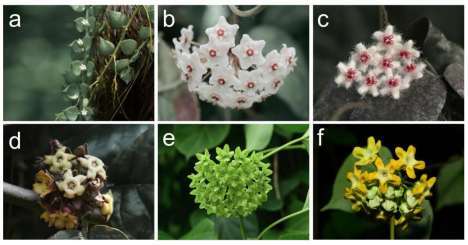
Floral diversity in Marsdenieae.
Published: 05 June 2026


