Nepenthes mirabilis (Lour.) Druce
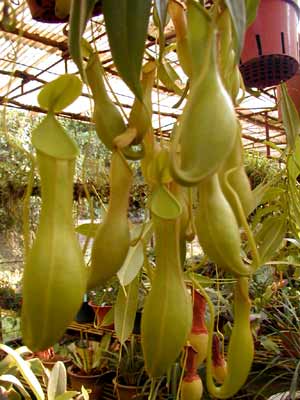
The lower part of the trap contains glands which absorb nutrients from captured prey. Along the upper inside part of the trap is a slick waxy coating which makes the escape of its prey nearly impossible. Surrounding the entrance to the trap is a structure called the peristome (the "lip") which is slippery and often quite colorful, attracting prey but offering an unsure footing. Above the peristome is a lid (the operculum): in many species this keeps rain from diluting the fluid within the pitcher, the underside of which may contain nectar glands which attract prey.[
Nepenthes usually produce two types of pitchers, known as leaf dimorphism. Appearing near the base of the plant are the large lower traps, which typically sit on the ground. The upper or aerial pitchers are usually smaller, differently-coloured, and possess different features than the lower pitchers. These upper pitchers usually form as the plant reaches maturity and the plant grows taller. To keep the plant steady, the upper pitchers often form a loop in the tendril, allowing it to wrap around nearby support.
 Appendix:
 Prev

