Colebrookea oppositifolia Smith
Feb 16, 2012
Colebrookea oppositifolia Smith
Kingdom:Plantae
Division:Magnoliophyta
Class :Magnoliopsida
Order:Lamiales
Family:Lamiaceae
Genus:Colebrookea
Species:Colebrookea oppositifolia
Description
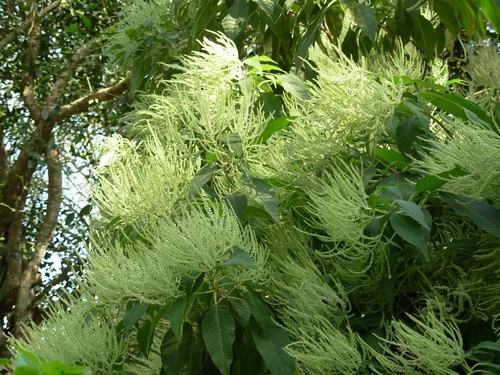
Colebrookea oppositifolia is a shrub that usually grows to about 3m high. The leaves are arranged opposite and are crowded together at the ends of branches. The small flowers are white in colour.
Flowering and fruiting seasons fall in January to April and March to April respectively. This herb is distributed throughout the northern parts of India, Bhutan, south western China as well as in Indo-China
and Nepal. They are found in open, dry and rocky places at altitudes of 1800m.
Properties
Haemostatic, anthelmintic, antiseptic.
Haemostatic, anthelmintic, antiseptic.
Medicinal Uses
Colebrookea oppositifolia can be used to treat dermatitis, nose bleeds, bleeding, coughing up blood and ringworms. In India, the leaves have been used in the treatment of wounds and bruises. Leaf
juice can be used to treat fever and has been applied topically to ease headache. Leaves can also be made into a poultice to treat dysentery. Root extracts can be used as a remedy against epilepsy
while the decoction of the roots is used to treat individuals with peptic ulcers.
Culinary and Other Uses
Colebrookea oppositifolia can be used as fodder. The branches are dried and used as fuel.
Colebrookea oppositifolia can be used as fodder. The branches are dried and used as fuel.
Safety Profile
No safety profile has been reported for this herb.
No safety profile has been reported for this herb.
 Appendix:
 Prev

