Study Reveals Evolutionary History and Genetic Basis of Spruce Diversification
Picea (spruce) is a conifer genus widely distributed across the Northern Hemisphere and a dominant component of boreal and montane forests. A well-resolved phylogeny of Picea is essential for understanding the evolutionary processes that have shaped diversification and regional differentiation across the genus. However, the evolutionary history of Picea has long remained obscure because of conflicting genetic signals.
In a study published in Cladistics, researchers from Lanzhou University and Xishuangbanna Tropical Botanical Garden (XTBG) of the Chinese Academy of Sciences investigated the phylogenetic relationships and evolutionary mechanisms of spruces by integrating transcriptomic data from 37 species. Their results showed that incomplete lineage sorting, rather than hybridization, was the dominant source of phylogenetic conflict in the genus.
The researchers adopted a pan-transcriptomic framework that circumvented the technical challenges posed by massive repetitive sequences in conifer genomes. By combining coalescent models, discordance region analysis, and network inference, they established a quantitative analytical framework for resolving complex evolutionary conflicts.
The study drew on 118 transcriptomic datasets, 43 of which were newly generated. It revealed that most spruce genes are highly variable: only about 9% are shared by all species and associated with basic cellular functions, whereas the remaining 90% differ among species and are linked to ecology and stress responses.
Using 405 low-copy genes, the researchers resolved four major spruce groups, with a rare western North American species, Picea breweriana, as the earliest-diverging lineage. They also found that about 275 genes are enough to reliably reconstruct the backbone of the genus.
However, beneath this stable framework, gene trees conflict extensively. The researchers traced most of this conflict (about 28%) to incomplete lineage sorting (a natural consequence of rapid, recent speciation in large, long-lived populations), rather than to hybridization (about 7%). Crossbreeding did occur, but it was geographically localized and was not the main driver of conflict.
The study also linked gene families to regional environments. Spruce lineages on the Qinghai-Tibet Plateau showed changes in stress and low-oxygen response genes, possibly reflecting waterlogged alpine soils. East Asian lineages showed shifts in protein regulation, while boreal lineages showed changes in photosynthesis and wood-related genes suited to short, harsh growing seasons.
Diversification rate analysis indicated higher rates in early branches during the Miocene, whereas extant groups generally exhibited lower rates.
“Our findings provide a phylogenomic framework for understanding diversification mechanisms in Picea. Conservation strategies should consider not only taxonomic units but also the evolutionary processes that generate and maintain genetic diversity. As climate change accelerates ,we should protect genetically diverse refugial populations and regionally differentiated variation,” said SUN Yongshuai of XTBG.
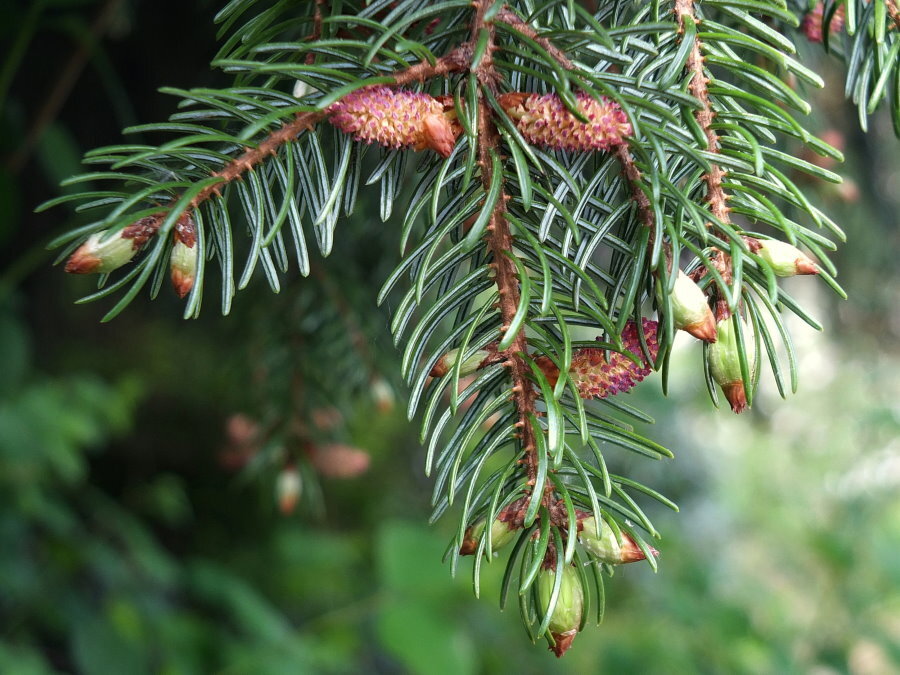
Picea breweriana (Credit: arthropodafotos.de)
First published: 24 October 2026
 Appendix:

