Ceropegia is a genus in the dogbane family (Apocynaceae), comprising approximately 200 species native to Africa, southern Asia, and Australia. To date, 24 species of Ceropegia have been documented in China.
During botanical explorations in the Luzhi River valley, Yunnan Province, researchers from Xishuangbanna Tropical Botanical Garden (XTBG) of the Chinese Academy of Sciences collected an unknown Ceropegia species. After a comprehensive literature review and detailed morphological examination, they confirmed it as a species new to science.
The newly discovered species was named Ceropegia polytricha, referring to its densely hairy stems, leaves, peduncles, corolla lobes, and interstaminal corona lobes. The finding was published in Taiwania.
Ceropegia polytricha is a perennial twining herb. It bears tubular, curved flowers measuring 4.7–5.2 cm in length. The corolla is yellowish-green with reddish-brown stripes, and the throat features a conspicuous ring of trichomes. The narrowly triangular lobes, reaching up to 2.7 cm in length, are densely pilose on the inner surface and fuse at the tips.
The new species is morphologically similar to Ceropegia dolichophylla and Ceropegia sinoerecta, but can be easily distinguished from them by having densely pilose stems, twining habit, broadly lanceolate leaves, and longer corolla lobes.
This new species is currently known only from Zhela Village, Luzhi Town, Yimen County, Yunnan Province, China, where it twines around branches in dense thickets. Local agricultural activities, including crop cultivation and livestock grazing, are contributing to habitat degradation. Therefore, the researchers have assessed its conservation status as critically endangered (CR), based on the IUCN Red List Categories and Criteria.
“This newly discovered species needs immediate conservation attention. Further surveys and habitat protection measures are urgently needed to safeguard it,” said SHEN Jianyong of XTBG.
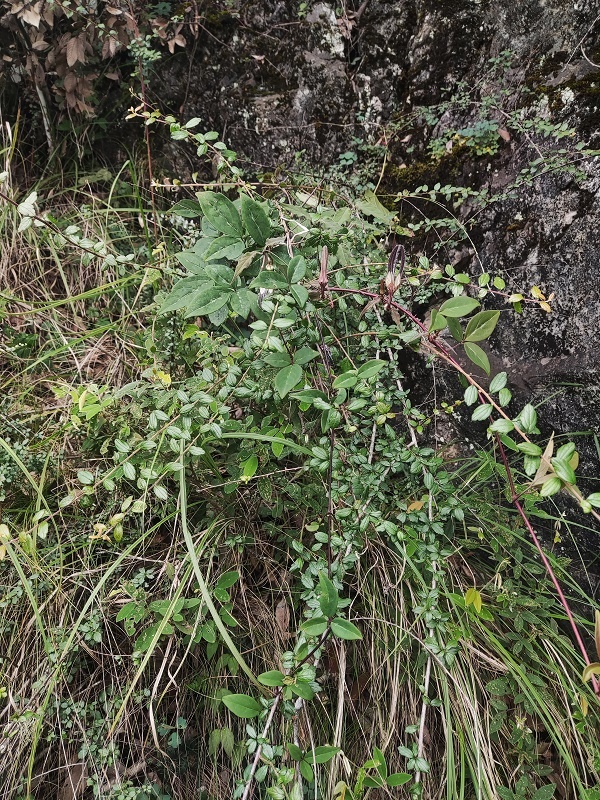
Ceropegia polytricha (Image by MA Xingda)
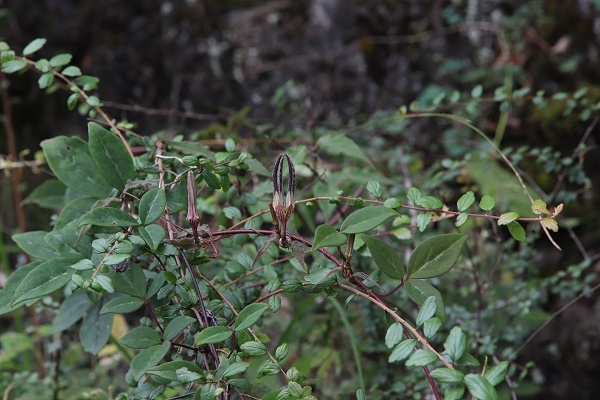
Ceropegia polytricha (Image by MA Xingda)
Published: 30 January 2026


