As industries develop, heavy metal pollution in soil has become a serious environmental problem. Phytoremediation, using plants to clean up contaminated land, increasingly recognized as an environmentally friendly solution for mitigating soil contamination. But for plants growing in polluted areas, survival is a struggle. They face a difficult choice: use their limited energy to defend against the toxic environment, or use it to grow. This trade-off directly affects how well they can help restore the ecosystem.
In a study published in Journal of Environmental Management, researchers from Xishuangbanna Tropical Botanical Garden (XTBG) of the Chinese Academy of Sciences explored the mechanisms by which plants regulate phytoremediation efficiency through growth-defense trade-offs in heavy metal-contaminated environments.
The team surveyed 21 plant species naturally growing in a lead-zinc-manganese mining area. By analyzing their physical condition and internal chemistry, they explored how these plants balance growth and defense when dealing with heavy metal stress.
The results showed that when exposed to toxic metals, plants actively adjust their strategy, shifting resource allocation away from growth and toward defense. They slow down their growth with reduced chlorophyll levels and ramp up their defense systems, producing more protective substances like proline and antioxidants.
Notably, the accumulation of proline, an osmoprotectant, showed a significant correlation with the phytoremediation processes of a wide range of metals, including zinc, lead, manganese, nickel, cadmium, cobalt, chromium, and copper.
Using advanced data modeling, the researchers confirmed that polluted environments push plants to defend themselves, but often at the cost of growth. The species that manage to keep a healthy balance between growth and defence tend to be more tolerant and more effective in restoring the land.
The findings suggest that phytoremediation success hinges not on growth or defense alone, but on the strategic balance between them. By investing less in growth and more in internal defense, these plants can survive and clean up complex pollution at the same time.
"The key to successful phytoremediation isn't just about how well a plant grows or how strongly it defends itself. It's about finding the right balance. Therefore, it’s important to select the right plant species to restore damaged ecosystems," said YANG Jie of XTBG.
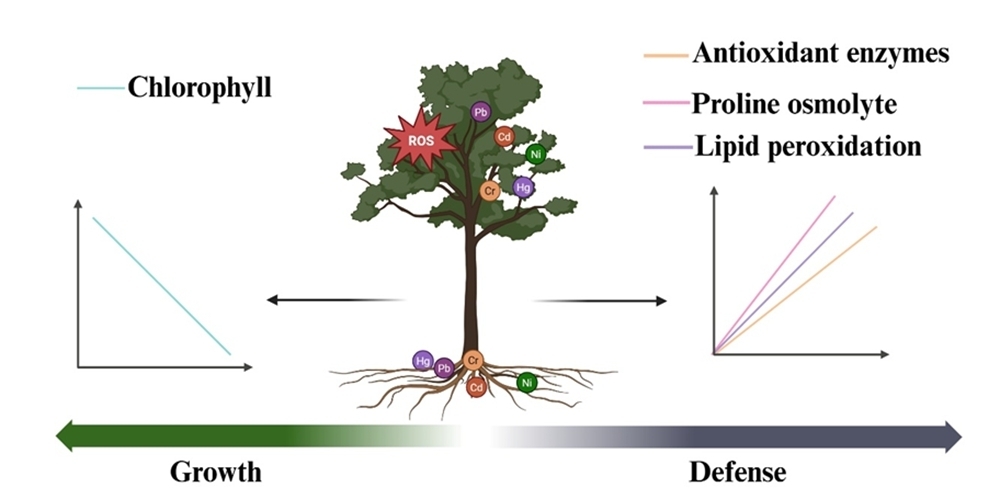
Plant growth-defence trade-offs in contamineted soil. (Image by Zeeshan Ahmad)
Available online: 9 March 2026


