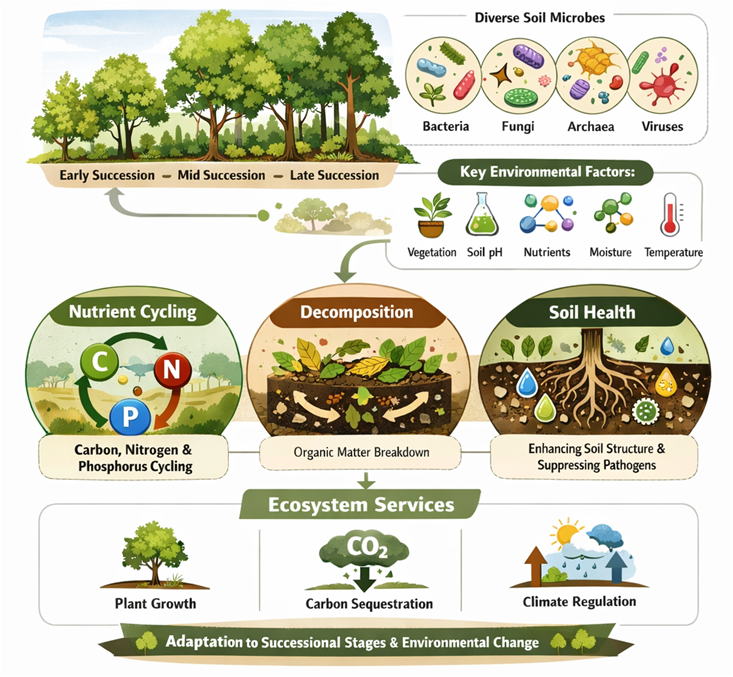
Forest succession is a fundamental ecological process that drives long-term changes in vegetation, soil properties, and ecosystem functioning. Soil microorganisms play a central role in these processes by regulating carbon turnover and nutrient cycling. However, previous studies have reported inconsistent patterns in microbial diversity and community composition across regions.
In a study published in Forest Ecosystems, researchers from Xishuangbanna Tropical Botanical Garden (XTBG) of the Chinese Academy of Sciences provided the first comprehensive synthesis of how soil microbial communities and chemical properties co-evolve during forest succession.
The researchers analyzed data from 83 studies and 306 sites worldwide, and revealed clear and consistent changes in soil properties across successional stages. Soil organic carbon (SOC) and total nitrogen (TN) increased significantly from early to late stages, while soil pH gradually declined. These shifts reflect the accumulation of organic matter and the development of more complex soil environments as forests mature.
Microbial diversity exhibited a nonlinear pattern during succession. Both bacterial and fungal diversity increased significantly from early to mid-successional stages, followed by a slight decline in late stages, forming a “hump-shaped” trajectory. This indicates that microbial diversity peaks at intermediate stages and transitions toward more stable communities in mature forests.
At the community level, a clear shift in microbial composition was observed. Early-successional soils were dominated by fast-growing, nutrient-demanding microorganisms. In contrast, late-successional soils were characterized by slow-growing, resource-efficient taxa such as. This transition reflects a shift from copiotrophic to oligotrophic life-history strategies as soil conditions change over time.
Further analyses identified total nitrogen as the most important driver of microbial diversity and community composition across all successional stages. In comparison, SOC and soil pH had weaker or stage-dependent effects. Climatic factors such as temperature and precipitation had stronger influences on bacterial communities, whereas fungal communities were more closely linked to soil nutrient availability.
This study demonstrates that forest succession drives coupled, directional changes in soil biogeochemistry and microbial community composition. “Understanding these microbial dynamics is essential for predicting forest carbon budgets and nutrient fluxes at regional and global scales,” said LU Huazheng of XTBG.
Contact
LU Huazheng Ph.D
Xishuangbanna Tropical Botanical Garden, the Chinese Academy of Sciences
E-mail: luhuazheng@xtbg.ac.cn
Published: 31 March 2026


