Understanding how mixed leaf litter from different plant species decomposes constitutes a fundamental step for predicting ecosystem responses to biodiversity loss and climate change. Soil animals play an important role in litter decomposition, and different groups of soil fauna differ in their ability to decompose litter. However, the complex interactions among litter diversity, functional traits, and decomposers have made it difficult to incorporate these processes into global models.
In a study published in Soil Biology and Biochemistry, researchers from Xishuangbanna Tropical Botanical Garden (XTBG) of the Chinese Academy of Sciences and their collaborators showed that macrofauna (large soil animals such as millipedes, woodlice, and earthworms) enhanced decomposition, but their activities weakened the predictive capacity of initial litter traits for decomposition dynamics.
The researchers investigated how different groups of soil fauna interact with litter functional traits to influence mixed-litter decomposition through a field experiment. They placed 972 litterbags with three different mesh sizes in a tropical rainforest in southwest China. To estimate the role of fauna by body size, they used three litterbag mesh sizes (0.07 mm, 2.0 mm, and 5.0 mm), which allowed access to microbes only, mesofauna, and macrofauna, respectively. Each litterbag contained leaf litter either from trees, lianas (woody climbers), or a mixture of both, mimicking natural litter layers.
The one-year experiment revealed that macrofauna significantly accelerated the decomposition rate of mixed tree litter and enhanced the mixing effect, but eliminated the predictive power of initial litter quality traits. When only microbes and mesofauna were present, initial litter traits (e.g., nitrogen content) effectively predicted decomposition rates. However, this relationship become inexistent once macrofauna were involved.
“Our results show that the importance of litter traits may vary among different soil fauna groups. Integrating fauna identity and size structure into decomposition models is a prerequisite for accurately predicting the ecosystem consequences of biodiversity loss,” said Dr. Gbadamassi G.O. Dossa of XTBG.
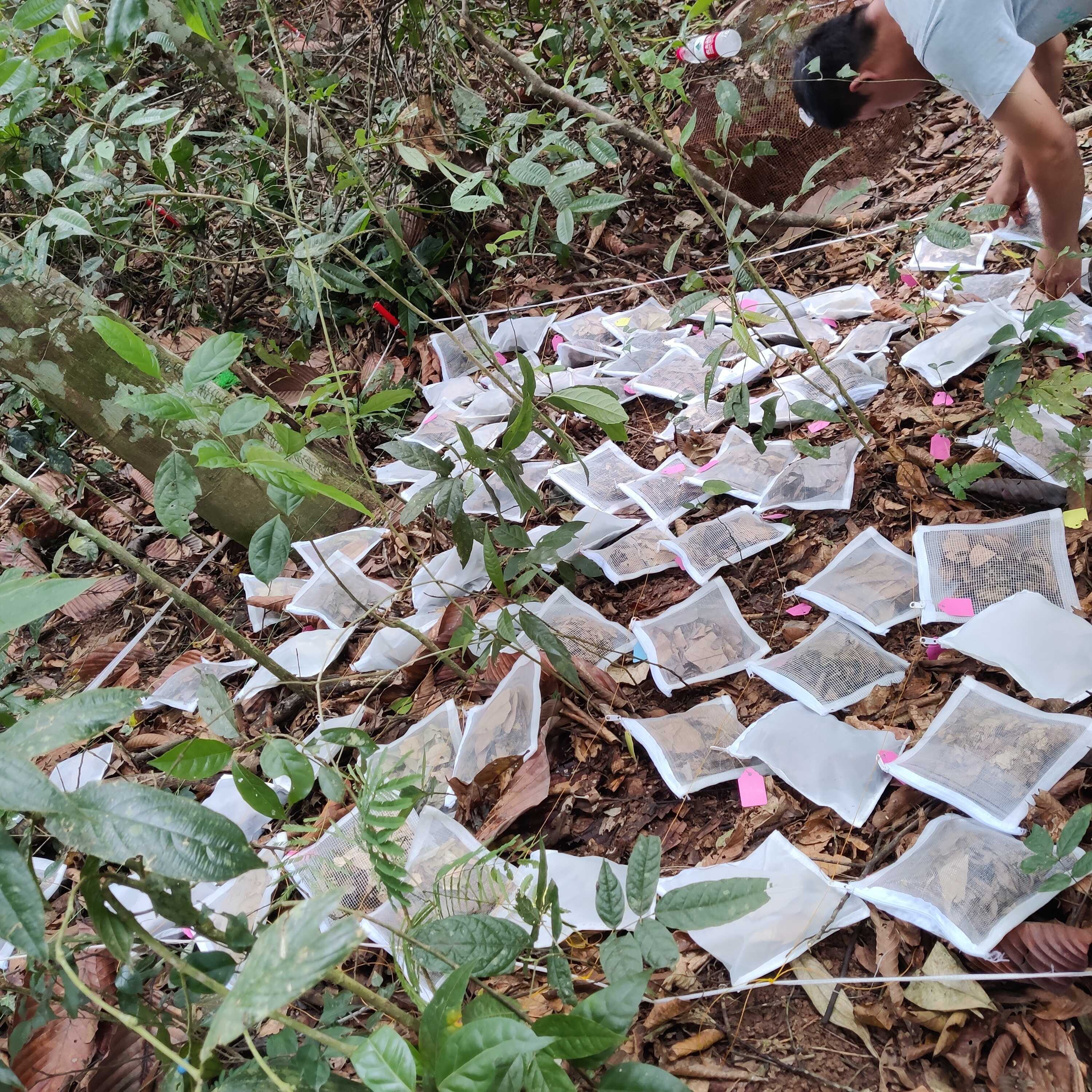
Field experiment testing how different groups of soil fauna interact with litter functional traits to influence mixed-litter decomposition. (Image by Gbadamassi G.O. Dossa)
Available online 17 April 2026


