In a study published in Journal of Applied Ecology, researchers from Xishuangbanna Tropical Botanical Garden (XTBG) of the Chinese Academy of Sciences demonstrate that off-the-shelf drones with infrared cameras can track wild Asian elephants at fine temporal resolution, offering a powerful tool for conflict mitigation and ecological research.
When a herd of 17 wild Asian elephants entered XTBG in May 2021, the researchers seized the rare opportunity to test drone-based surveillance under real-world management conditions. Over 20 consecutive days, they conducted hourly infrared monitoring, collecting high�frequency data on the elephants’ locations and behavioural patterns.
Despite challenging conditions, including monsoon rains and high humidity, the drone achieved an overall success rate of 62.7% in locating the elephants. Detection rates peaked dramatically during the night, reaching an impressive 95% near midnight, a critical time when most human and elephant conflict incidents occur. The infrared camera proved especially valuable in low�light conditions and beneath dense forest canopy, where conventional visible-light cameras often failed.
The elephants' activity patterns were heavily influenced by human presence. Movement peaked during twilight hours (7:00-8:00 AM and 8:00-9:00 PM), when human activity within the botanical garden was at its lowest. This clear temporal niche partitioning suggests that elephants actively adjust their schedules to reduce encounter risks.
"Our findings show that drones can provide the real-time data needed to manage conflict effectively, even in challenging forest environments," said DENG Yun of XTBG.
Step�selection function analysis further revealed that elephants exhibited a strong preference for areas near water sources and on gentle slopes, while canopy structure and vegetation density had negligible effects on their habitat choices.
The study has direct applications for human-elephant conflict mitigation. Between 2011 and 2020, Asian elephants were responsible for 35 human deaths and 29 injuries in Xishuangbanna-. During the 20-day trial, the drone monitoring enabled staff to adjust site operations in near-real time, and no major human-elephant incidents were recorded, demonstrating the immediate conservation value of the approach.
“These findings indicate that drone monitoring can effectively support real-time early warning systems and provide scientific evidence for mitigating human-elephant conflicts. We recommend prioritizing night flights and focusing searches along key areas such as riverside corridors,”said Ahimsa Campos-Arceiz of XTBG.
The researchers emphasize that drones should be viewed as complementary to, not replacements for, existing monitoring tools, strengthening an integrated early�warning framework rather than displacing proven ground-based methods.
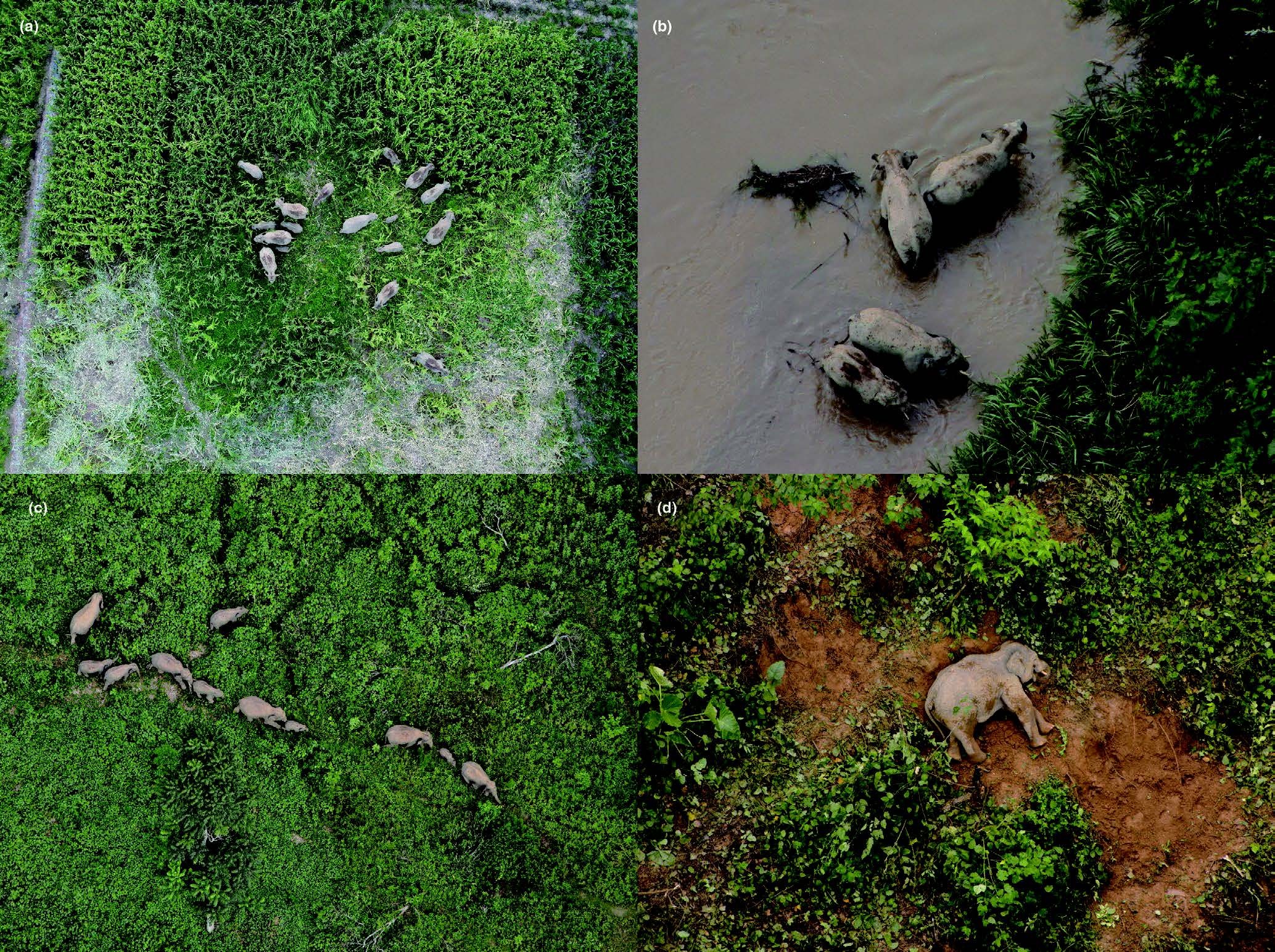
Examples of elephant behaviours: (a) feeding; (b) drinking/bathing; (c) moving; (d) resting (Image by XTBG)
First published: 25 June 2026


