Wood formation, driven by secondary xylem differentiation from the vascular cambium, is essential for structural support, hydraulic efficiency, and carbon storage in vascular plants. However, the regulatory mechanism of secondary xylem differentiation in rubber trees (Hevea brasiliensis) remain unclear.
In a study published in Plant, Cell & Environment, researchers from Xishuangbanna Tropical Botanical Garden (XTBG) of the Chinese Academy of Sciences have unveiled the first high-resolution single-nucleus transcriptomic atlas of xylem development in rubber trees. Using single-nucleus RNA sequencing (snRNA-seq), they traced the developmental journey from cambium to mature xylem and identified a novel transcription factor cascade that regulates secondary cell wall (SCW) formation.
The researchers collected stem tissues from two developmental stages, juvenile (EU2) and mature (EU5), and generated a comprehensive snRNA-seq dataset comprising over 21,000 nuclei. This enabled them to resolve 17 transcriptionally distinct cell clusters, representing cambium, xylem mother cells, fibre/vessel cells, and xylem parenchyma.
They identified HbWRKY12a, a transcription factor from the WRKY family, as a negative regulator of SCW formation in rubber tree xylem. HbWRKY12a is preferentially enriched in fibre-vessel cells, pointing to a specialized role in xylem SCW formation.
They further uncovered a novel regulatory cascade, revealing that HbWRKY12a directly binds and activates HbMYB1R1c, a member of the non-canonical CCA1-like MYB family. This regulator then modulates genes associated with lignin biosynthesis, a key component of secondary walls. This finding extends the classical NAC-MYB regulatory framework for SCW formation, introducing a WRKY-MYB module.
"Our findings reveal a regulatory relationship between HbWRKY12a and HbMYB1R1c that contributes to lignin-associated SCW modulation," said SUN Guiling of XTBG. "This discovery illustrates functional diversification within the WRKY family and provides new insights into the transcriptional control of xylem differentiation in rubber trees."
Beyond advancing fundamental knowledge of xylem biology in rubber trees, this study provides promising molecular targets for improving wood properties and stress tolerance. Since thinner secondary walls are correlated with reduced drought resistance, fine-tuning HbWRKY12a activity could offer a strategy to balance growth and environmental adaptability in tropical crops.
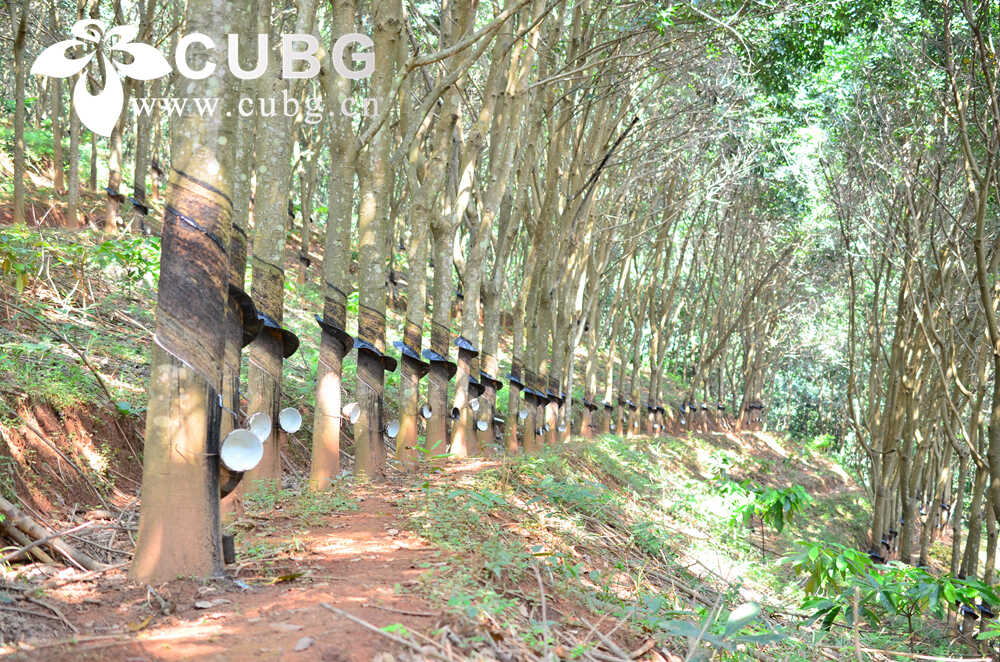
Rubber trees. (Image by ZHU Renbin)
First published: 12 July 2026


