Flowering time is critical for ecological adaptation and agronomic improvement. The Brassica genus, which includes Chinese cabbage and rapeseed, has spread across diverse latitudes and altitudes, forming a wide range of ecotypes. Understanding how flowering time is regulated in turnip can provide insight into adaptive evolution and support efforts to breed climate-resilient crops.
In a study published in Plant, Cell & Environment, researchers from Xishuangbanna Tropical Botanical Garden (XTBG) have identified natural variation at the BrrPRMT10 locus as a key modulator of flowering time in turnip (Brassica rapa subsp. rapa), offering new insights into ecotype adaptation and a potential target for breeding climate-resilient Brassica crops.
The researchers analyzed 32 turnip core germplasm accessions collected from major production regions. Based on flowering behavior and vernalization requirements, the accessions were classified into two ecotypes: winter annual, and semi-winter annual. No typical spring-type was identified. Two accessions, B58 and B70, showed extreme flowering phenotypes.
To uncover the genetic basis of these contrasting phenotypes, the researchers crossed the homozygous lines B58 and B70 to develop an F₂ population. Flowering time in the population ranged from 75 to 209 days and showed a normal distribution. Bulk segregant analysis of extreme early- and late-flowering pools mapped a high-confidence flowering-time quantitative trait locus (QTL) to a 4.30-Mb interval on chromosome 2 (6.20–10.50 Mb).
The interval contained 753 annotated genes, of which 436 harbored nonsynonymous variants and 13 were homologous to known flowering regulators. The strongest association peak spanned 7.20–9.20 Mb, with an Euclidean distance score of 0.481. Within this region, the candidate gene Gene0023913.1, located at 8,580,386–8,582,168 bp, encodes a homolog of PRMT10, a protein arginine methyltransferase.
Functional and transgenic experiments indicated that natural variation at this locus, named BrrPRMT10, affects flowering time and the expression of BrnaFT2, a key flowering-time regulator. The study also found differences in methylated product levels, PRMT activity, and hydrogen-bond dynamics around the Arg54–Asp58 region between BrrPRMT10 variants, suggesting that structural and biochemical changes underlie the allelic effects on flowering.
“Our study identified BrrPRMT10 as a major regulatory gene for flowering time in radish through multi-omics approaches and deciphered the functional significance of its key amino acid variation (S63A), offering theoretical foundations for developing climate-resilient crop varieties,” said ZHENG Yan of XTBG.
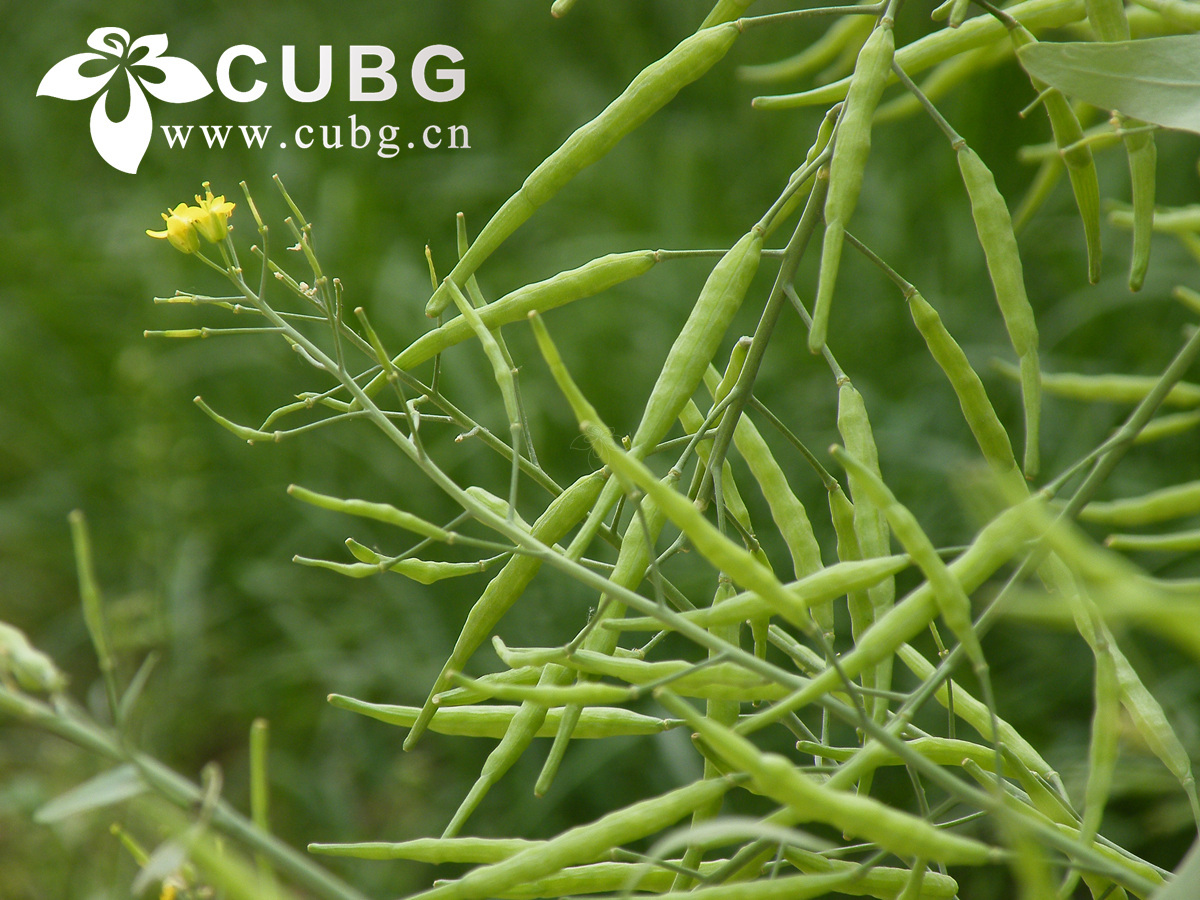
A Brassica species. (Image by ZHU Renbin)
First published: 07 September 2026


