Global land-use reconfiguration has caused ecosystem services and economic services to become intertwined and interactive in shared spaces, intensifying conflicts between development and the environment. Traditional incentive-based zoning approaches have proven inadequate for managing these trade-offs and conflicts.
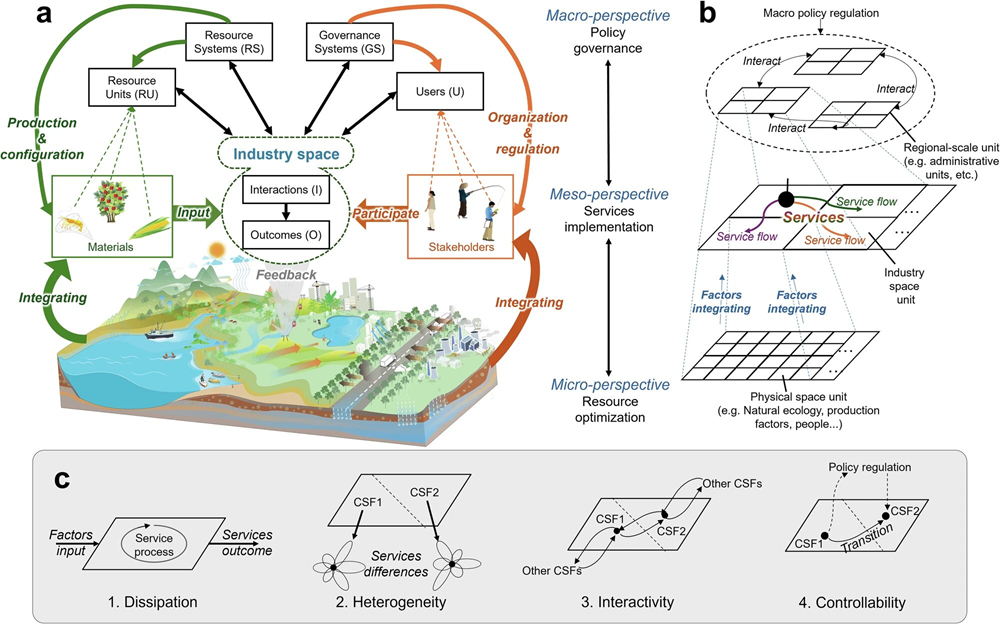
In a study published in npj Urban Sustainability, researchers from Xishuangbanna Tropical Botanical Garden (XTBG) proposed a new spatial governance framework termed “Industry Space”, to address the growing conflicts between economic development and environmental protection. It aims to help resolve the question how to meet economic and social needs without degrading the ecosystems that support them.
Rooted in social–ecological systems (SES) theory, Industry Space treats natural ecology, industrial activity, social needs, and governance structures as a coupled whole. It uses a source–flow–sink framework to explain how services diffuse and attenuate across space, revealing how synergies and trade-offs between ecological and economic services shape regional well-being. The framework also introduces the concept of supply–demand adaptation, emphasizing dynamic balance between what is required and what can be supplied as a basis for long-term system resilience.
It advocates multi-level governance, stakeholder participation, and iterative adjustments to address cross-scale and uncertain socio-economic and environmental changes.
The researchers say that the framework is generalizable to rapidly urbanizing emerging economies, resource-rich energy-producing regions and developed metropolitan areas pursuing carbon neutrality.
“We need a new paradigm that merges industrial planning with ecological management, breaking down sectoral silos to achieve an organic coupling of different services in space,” said BAI Yang of XTBG..
This framework offers a novel perspective for integrating macro-level governance with micro-level planning and promoting synergy between industrial development and ecological conservation, providing a reference point for global sustainable transitions.
Published: 08 June 2026


