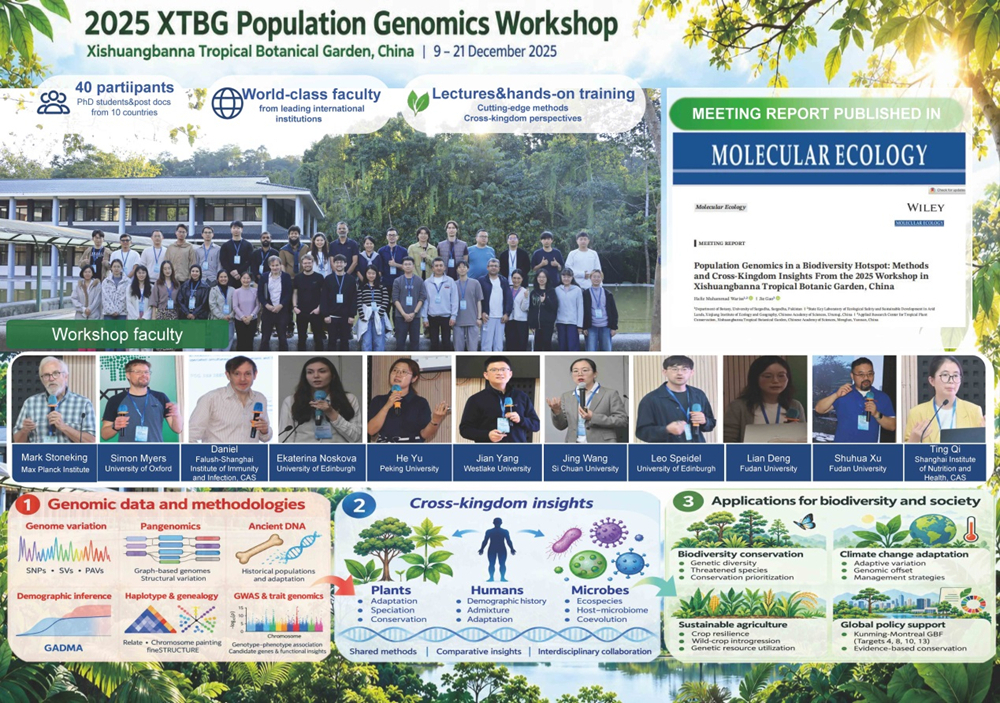
A meeting report published in Molecular Ecology summarizes key advances in population genomics and cross-kingdom applications based on the 2025 XTBG Population Genomics Workshop, held from December 9 to 21, 2025, at Xishuangbanna Tropical Botanical Garden (XTBG) of the Chinese Academy of Sciences.
The workshop trained 40 participants, primarily PhD students and postdoctoral researchers from China, Pakistan, Thailand, Indonesia, Malaysia, Egypt, Nepal, Japan, Singapore, and Russia. It featured experts from institutions including the Max Planck Institutes for Evolutionary Anthropology, the University of Oxford, RIKEN, the University of Edinburgh, Fudan University, Peking University, Sichuan University, Westlake University, and the Shanghai Institute of Nutrition and Health, CAS. Many of the instructors are core developers of key population genomics methods and tools.
According to the report, population genomics is moving from descriptive genetic surveys to an integrative, model-aware science of evolutionary history. It highlights a shift from summary statistics to explicit evolutionary models, from linear reference genomes to pangenome graphs, and from isolated analyses to cross-kingdom synthesis.
These developments, supported by a growing emphasis on computational transparency and reproducible workflows, position population genomics as a powerful tool for reconstructing life’s history across scales.
For plant science and conservation, the researchers argue that these advances can directly support the Kunming-Montreal Global Biodiversity Framework (KMGBF). Model-based demographic inference can help distinguish natural population structure from anthropogenic fragmentation, informing Target 4 on species recovery and genetic diversity and Target 8 on climate-change impacts and resilience. Pangenome graphs and structural-variation-aware methods can accelerate climate-resilient breeding and sustainable use of genetic resources under Target 13. Population-structure-aware approaches to plant microbiomes may also open new avenues for harnessing the plant holobiont in sustainable agriculture.